Restorative Dental Implants

Restore the function of your bite and the beauty of your smile with precision restorative dental implants in East Tucson.

Why Choose Dr. Noseck for Implants

Expertise You Can Trust

The Fellowship Advantage:

Dr. Ryan Noseck holds an advanced Fellowship in Implantology, a distinction that sets him apart from general dentists. He doesn’t just “place” implants; he meticulously plans the restoration to ensure perfect alignment, a comfortable bite, and a natural aesthetic.

Our "Quality Over Quantity" Promise:

We perform implant surgery in a calm, controlled environment. You are never just another appointment on a surgical calendar; Dr. Noseck personally oversees every step, from the initial 3D imaging to the placement of your final custom crown.

The Implant Process

Comprehensive Digital Planning

We use high-resolution digital imaging to assess your jawbone density and map out the precise placement of the implant.

Gentle Placement

Using local anesthesia or sedation (Nitrous Oxide), the titanium post is placed. Most patients report that the procedure is surprisingly comfortable.

Healing & Osseointegration

Over a few months, the implant fuses with your bone, creating a rock-solid foundation.

The Final Restoration

Dr. Noseck custom-crafts a porcelain crown and attaches it to the implant. You walk out with a complete, functional smile.

What is a Dental Implant

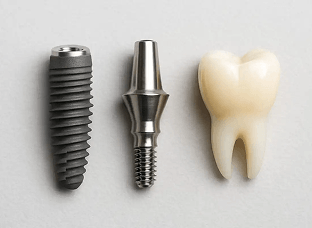
A dental implant is a small threaded screw made out of titanium. Titanium is a
“biocompatible” material. This means that bone likes it. Most foreign substances, when placed in the body, cause an immune reaction (ie. a sliver in your finger or a bullet in your gut.) But, with titanium, no immune reaction is generated. In fact, bone actually grows onto the titanium
How is the Implant placed?

If you’ve ever screwed a screw into a piece of wood, then you already know the basics of implant placement. First, you drill a pilot hole into wood, to a size slightly smaller than the screw diameter to be placed. Then, you turn your screw into that pilot hole in a clockwise motion engaging the threads. As the screw gets deeper into the wood, the screw exerts force on the wood and holds it in place.

Now, substitute implant for screw and bone for wood. I make a small incision over where the implant is to be placed. Tissue is reflected and bone is smoothed. I have a series of pilot drills I use to create the
“osteotomy” or pilot hole. I drill to just shy of the desired implant diameter. The implant is then placed and “screwed in” to a specific torqueing force depending on the density of the bone. I have computers that measure this force because it is very important this is done specifically and correctly. Once the implant is placed, a small cap is placed over the orifice of the implant and the tissue is sutured over the top of the implant, completely submerging it.
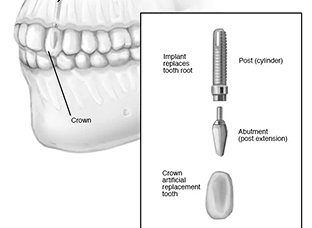
Single Implants

If you are missing one tooth or several teeth, implants offer patients the most functionally and esthetically realistic option for tooth replacement in dental technology today.

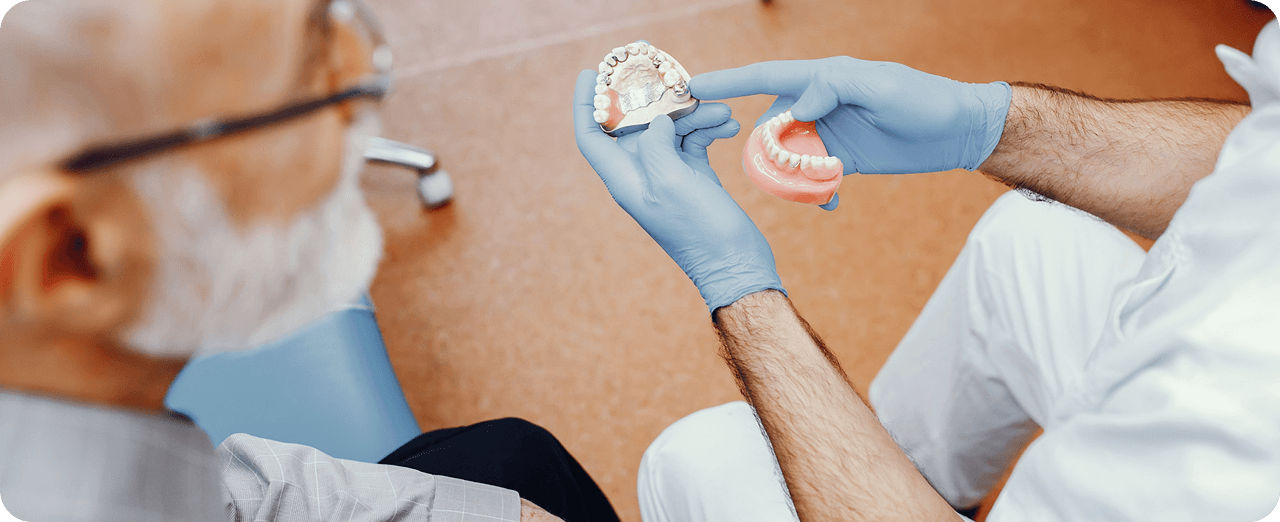
Two or four Implant Retained Denture

Specifically, one of the most common patient complaints is a poorly fitting or “loose” denture. For many years, these patients’ only option was a “denture reline” or “complete denture remake” which never seems to truly fix the problem. Today, dental implants offer a realistic solution.
With as few as 2 implants placed in the anterior aspect of the jaw, a dramatic improvement in stability and retention can be achieved. Small clips or female attachments are incorporated into a new denture (or your old denture). This allows the denture to “snap” into place. The patient is able to function with only slight denture movement in the posterior.

Four Implants

With a minimum of 4 implants, a marked improvement in stability can be achieved over the 2 implant design by use of a titanium or metal bar. The bar is fixed onto the implants with screws. The denture
“snaps” (very solidly) onto retentive features incorporated in the design of the bar. This option offers the advantage of complete stability while still allowing the patient to remove the denture for hygiene and
maintenance.

Five Implants

With a minimum of 5 implants (and sometimes four, depending on the situation), the edentulous patient can have a full arch of fixed teeth. This option is perfect for the patient who does not want anything removable. This type of “horseshoe-shaped” prosthesis is termed “fixed-detachable” because it is fixed to the patient (you can’t remove it). But, Dr. Ryan can remove it if necessary for routine maintenance or rework.

Six Implants or More

With a minimum of six implants or more, edentulous patients can enjoy full fixed crowns and bridges as with natural teeth.

An Investment in Your Confidence

We believe everyone deserves a healthy smile. We offer transparent pricing and flexible financing through CareCredit, including 24-month no-interest plans. We also work with all insurance providers to maximize your benefits.

Faqs

Your questions answered

See why Tucson families have trusted Dr. Noseck with their dental health for over 50 years.

Yes! We are always happy to welcome new members to our patient family. Whether you are looking for a routine cleaning or have a specific dental concern, you can reach out to our team at (520) 886-5477 to schedule your first visit.

Nitrous Oxide & Sedation

Everyone hates going to see the dentist...

But, some people (and you know if this is you) have a DEEP phobia of the dentist. I mean, a REAL visceral response to the very thought of going to see the dentist.

Many times, I have found this fear to be connected to a bad past experience that occurred in a dental office when the patient was very young. It’s amazing. I have 90 plus year old patients terrified of the dentist because of a bad experience that happened when they were six!!!

I understand these fears because I’ve had them myself. I’m very relaxed when I’m doing dentistry. But, if you put me in that dental chair (or any doctor chair), my heart starts to race, palms get sweaty, brow dampens, you know the routine. I can’t stop this response no matter how hard I try to relax. And, needles... don’t get me started!!! I give somewhere between 20 and 30 injections a day. No problem. But when I’m the one on the other end of that needle… the heart races, palms sweat, etc!!!

So, I have a deep compassion for these patients who are terrified of the dental office. I understand them, cater to them, and, as a result, have many of them in my practice. In terms of sedation options, I have tremendous success with nitrous oxide. I also offer oral sedation (i.e. taking a pill like valium or halcion.) But, I find many advantages to nitrous oxide.

Nitrous Oxide is “laughing gas”. It’s what you always see in the movies (like Steve Martin in Little Shop of Horrors!!) Basically, it’s a gas that you breathe in through the nose. The gas is combined with oxygen which acts to dilute it. This combination of nitrous and oxygen has two advantages: One, it gives me direct and quick access to OXYGEN which is invaluable to any medical emergency, medically compromised patient, or high anxiety patient. And second, it allows me to regulate the amount of nitrous oxide the patient receives. Unlike taking a pill, you are not stuck with the over effect (or under effect) of the amount taken. Nitrous concentrations can be changed at will throughout the appointment until a perfect “level” of sedation is attained. If my patient has too much of an effect, I turn it down. If my patient is not relaxed enough, I turn it up. Very simple. And, in the RARE cases where the person does not like the feeling of nitrous oxide, I turn it off, run 100% oxygen, and the person is back to normal in less than 2 minutes. This is something you CAN NOT do with a pill.

All patients can drive home after nitrous oxide, by the way.

A lot of people ask me, “What is it like being on nitrous?” Well, I always the start the person on 100% oxygen and slowly bring in the nitrous. The beginning effects are a very gentle, tingle in the fingertips or a warm “fuzzy” feeling inside. (It’s hard to explain.) But, it is a comforting, good, feeling. As the person becomes used to this initial feeling, I SLOWLY turn the nitrous up and talk to the patient as the effect increases. I adjust the concentration until the patient tells me they are in a good place. A “good place” is comparable to having a glass (or two??) of wine....

I never put my patients “to sleep”. My goal is to get them in a comfortable and relaxed place. Sometimes, people say that they don’t feel any different, but they notice they are no longer nervous. This, to me, is the perfect level of sedation. I like people to be awake, communicative, in control, and, most importantly, relaxed. If the person is still nervous, I will increase the nitrous concentration to a deeper state of sedation until my patient is comfortable.

Once my patient is comfortable, I ask them if they are ready to be numbed. (I never proceed until the patient is ready.) In terms of local anesthesia, I ALWAYS presoak the area in a topical gel that pre-numbs the area so the person does not feel “the shot”. In addition, I have received special training and have many techniques in giving painless injections. I am confident I can give a painless injection everywhere in the mouth except for the lower molars. Due to anatomy in this area, there can sometimes be a “pinch” (maybe 20-30% of the time??). If the patient is on nitrous oxide, this percentage is more like 5% But, regardless, I always prepare the patient for this and minimize it as much as possible.

Next, I will ALWAYS test the area before beginning the procedure. I will not begin ANY procedure until I know the patient is completely numb, relaxed, and ready. I urge patients to TELL ME if they feel ANY sensitivity or do not feel relaxed at any point in the procedure. To me, a dental procedure is a constant conversation. I explain as I go (if the person wants to know..) and introduce each successive part of the procedure while constantly adjusting the nitrous level.

Overall, I have many “dental-phobics” as patients because I take the time to make sure they are comfortable. I don’t rush through procedures. And, I don’t make patients feel bad if we need to stop and make sure adequate anesthesia is attained.

I am here for you. Nitrous Oxide is great stuff and, believe it or not, can make seeing the dentist actually kind of fun. In addition, I have many patients who have used nitrous oxide as a tool to overcome their fear of going to the dentist. Many people who formerly used nitrous now no longer need it.

So, if you have been putting off going to the dentist for many years (OR if you’ve just begun putting off going to the dentist), you really should give me a try! I also don’t make people feel bad for avoiding seeing the dentist for years and years. In terms of number of years since last seeing the dentist, I NORMALLY get numbers like 20 years, 30 years, even 40 years plus!!! So, don’t feel bad! Just remember, the longer you wait, the more extensive (and expensive) the treatment gets!

Yes

Your First Visit

At your first visit, Dr. Ryan will take a detailed medical history, record all patient concerns and complaints, conduct a comprehensive exam, and take a full series of X-Rays. Study models and photos are taken with more involved cases. The comprehensive exam consists of a restorative evaluation (looking for cavities), a periodontal evaluation (evaluating gum tissue), a soft tissue cancer screen, and TMJ  evaluation.

If there is work to be done, patients will be brought back for a consult to discuss the exam. A detailed treatment plan will be presented to the patient outlining all proposed treatment. Patients will leave the consult knowing all dental options, exact cost of the various levels of treatment, and what percentage of that cost will be covered by insurance. (Our office also provides payment plan options.)

Dr. Ryan encourages patients to bring all questions or concerns to the consult. It is a time for the patient to be educated on their dental condition in a supportive and positive way. In understanding the many wonderful treatment options available to patients in our practice, anxiety levels are often lowered by this experience.

We Offer Financial Arrangements with Care Credit, Up To 2 years No Interest.

Treatment plans are established foremost. Care is taken as so patients know and understand their treatment options, cost of treatment, and insurance coverage before any treatment is rendered. We take Delta insurance plans and accept (and submit for) ALL insurances; however, we are out of network. Our practice also offers free consultations and payment plans.

Send us a message

    Contact Us

    Get in touch with us.

    Location

    50 North Camino Seco Tucson, AZ 85710

    Phone

    (520) 886-5477

    Office Hours

    Mon – Thurs: 7:30am – 5:30pm

    Email

    ryannoseck@hotmail.com